Showing posts with label Urfa Life. Show all posts

May 29, 2014

Life here yani

Driver pulls over. Ben Suri. I'm Syrian.

Riding shotgun down the highway smoking a menthol cigarette.

Içmiyorum 'I don't smoke'. Ama 'but' nane 'mint'...nane... ok.

Kadir is belting Arabic ballads with the radio... kalbim 'my heart' why are you going?

I'm snapping my fingers high on nicotine.

Seat belts are fastened behind our backs so the car won't complain.

It's all Turkish mixed with Arabic.

Iki sene 'two years' in Turkey. Savaş 'war'.

He just dropped his brother at the airport. Sud Arabistan. Riyadh.

Hayat 'life'.

Hayat zeyn! Life is good!

I'm 28. I'm 23. So young! But you look like you are 20. I know I know. 

I'm on the phone with his sister now. Merhaba. Iyi misin? Maalesef arabi bilmiyorum. Mafi arabi. Zeyn. Zeyn. Inshalla görüşüruz.

He's on the phone now. Sadiqa arkadaş kız binit mn kanada kanada.

Is it the cigarette? I can understand everything.

Kadir takes off his sunglasses. Oh he is 23. Baby face. Those black lashes.

I point out my street. He drives past it. Kidnapped for tea. His mother insists. I insist more. My coolness ends here. 

Phone number written on paper. Turkish girls staring when I get out of the car, sunglasses and hiking poles, shouting goodbye at this car driver in skin-tight white and matching capris. 

What a life. This funny city near the border of chaos. These interactions.

May 26, 2014

Woman on a Bicycle


Last night in the park I saw a woman on a bicycle. She had a long blue skirt and a white headscarf that stood out in the darkness of the walking track.

Here in Urfa I have never seen such a thing. In six months in Turkey, actually, I haven't seen such a thing–a local woman on a bicycle.

This woman braked next to me as I was walking laps. I immediately told her how wonderful she was. Was it her bike? Yes. I said that I too had a bike, in Canada. Did she ride it often? Yes. Every Sunday night. She likes it and is losing weight. The woman said that riding a bike was more fun than walking, and did I want to take it for a lap? I said no (it looked small), but encouraged her to continue. We grinned at each other every time we passed.

In stopping to talk, she interrupted a chain of thoughts about what I did and didn't do in Urfa. There is no expatriate culture here, at least that I know of, and I felt an immediate keenness to fit in and have a low profile. I dyed my hair a darker colour and dressed more conservatively. I wore a flat expression and saved my smiles on the street for women. A friend mentioned I could buy a bike in Urfa, but I immediately dismissed the idea as not only physically dangerous (where would I ride it? there is no such thing as a bike lane here) but also socially unacceptable.

Socially unacceptable how, though? No one would stone me. No one would tell me to get off the bike. I didn't want to make a scene, is the real reason.

When I'm abroad, I like to blend in. It kills me when visitors speak loudly on the bus (don't they notice how reserved everyone else is?! don't they hear how much English stands out?!). Of course I will never blend in–at least not in this region, where I don't look like any of the ethnic groups–but I like to do what I can.

This may be a weakness. A savvy international type (I still don't know where he's from or what his first language is) once told me I was the worst kind of traveler. I adapt. I avoid causing friction or conflict. What a disservice I was doing, he said, to the people in the places I visited. They might never travel widely, physically or through books or movies or discussions, and my interaction was perhaps their best shot at being shocked into considering other ways of living.

One counter-argument is that there are subtler ways to broaden people's ideas than explicitly going against the grain. But let's save the counter-arguments.

I didn't get a bike here. I kind of wish that I had.

May 16, 2014

3 Things I Really Notice


...upon returning to Turkey, in particular the southeast, after five days in the Republic of Cyprus.

1. The heat


Before this jaunt to Cyprus, I had forgotten the finicky dampness of the mountains, and the temperature shift that other places experience when the sun goes down. Here the weather is reliably hot. Morning, noon, and night. When I walked down the steps from the airplane in Gaziantep, back into the encompassing heat, I remembered flying into Saudi.

2. The helpfulness


People here are truly helpful. Outside the airport I asked a man how to get to the otogar. He said that the transfer bus should go there, but to check with the şoför, whom he naturally called over. The şoför confirmed, took my bag, and invited me onto the bus. Several people on the bus made sure that I succeeded in getting off at the otogar.

I can't help but compare this to the events the same morning in Cyprus, in which I was stranded in a village because the bus driver opted to drive past me at the village centre bus stop. I was less annoyed with the driver (after all, I was on the wrong side of the street after forgetting about the British system) and more annoyed with the tables full of local men who had observed me sitting on the side of a road with a backpack for 10 minutes leading up to the bus and 10 minutes after it went by, without saying anything.

"Oh, the customer service in Turkey!" someone exclaimed recently. But that suggests that the excellent service is only for customers. It's not. Most of the help I receive is from random strangers who will never benefit in any material way from me. I need to keep reminding myself that the rest of the world is not like this (but probably should be).

3. The ease


Outside the otogar of Gaziantep–I don't even have to go in or ask–a man finds me a bus to Urfa and takes my 20 lira for the ticket price. When I board the bus, an attendant asks for my ticket. I don't have one, I say. I payed that guy outside. Oh, no problem. Such is the degree that you can trust people in Turkey (Note: Istanbul is another country). I am given as much free water as I like. The bus stops for us to rest and eat. The bathroom costs the usual 1 lira, but of course it is reliably clean. The self-service restaurant serves its reliably good stews. Even though I have paid and sat down, it is still not too late to ask for a fresh ayran for which the waiter takes a lira. Fellow passengers and bus attendants let me know when the bus is leaving. Back in Urfa, I walk through dark streets to my apartment without worrying for an instant about safety. I know much of this has to do with speaking some Turkish and having spent time here, but still, still, it's easy.

May 7, 2014

'Singleness is sultanness'


Bekarlık sultanlık

This is an actual saying in Turkish. I think about it fairly frequently.

My new waxist, aged 18, asked me if I was married or single. Single, I said. Nice, she said. She doesn't like being married, not at all. Her parents both died, though, and all her older siblings are married, so perhaps she had no choice. She's working at the beauty salon to save money for a vacation in western Turkey. At this thought her face lit up.

Yesterday two women and I were walking in the fields outside of a village and we stopped to talk to an old man that was flooding a field for cotton planting. He wanted to know about me. Why don't you marry someone from this village? He asked. I'm not thinking about marriage, I said. Bekarlık sultanlık, he conceded.

April 14, 2014

My favourite text message


Güvercinler benimle istanbula gelecekler.

The pigeons will come with me to Istanbul.

April 8, 2014

Şalgam or ayran?

Basically the question out here.

Astringent juice made of Russian turnips, or frothy salty yogurt water.

I'm not joking when say it's hard because they're both so good.

March 28, 2014

Political Billboards of Urfa

Is it weird that I take photos of these?

In honour of the local elections on Sunday:


1. Think big

Back in February the AK Party messages were broad and vague. For a while I thought this said, "Big thought" which of course makes no sense. Prime Minister Erdoğan is on the right. On the left is the AK Party man running for Urfa mayor.


2. There's no stopping; keep going

Another AK Party man, this one for Karaköprü mayor. *There are 3 or 4 municipalities within greater Urfa. I am still not clear.

This candidate looks like a hopeful child. I love that his last name means "farmer."


3. While we're talking about awesome names...

Ibrahim "Black Cloud."

He's using the political buzzword of the season, hizmet (service). He's running for a neighbourhood muhtar position, which translates to "chief" or "headman".


4. Seriously?
This man's last name means "screaming". He's running against Black Cloud, and also talking about hizmet. "It's not for money. It's for service," he says.


5. Interrupting this billboard tour to announce that

"Obama is living a forbidden love with Beyonce?"

In case you wondered about Turkish news coverage of the Western world.

6. The BDP, i.e. the Kurdish party

They have so much going for them aesthetically.

A) Awesome colour scheme (which apparently used to be forbidden)
B) Tree
C) The name? "Peace and Democracy Party"

7. Women, smiles!

They also have women running for positions, and people who smile for photographs (this is not even the best example).

A friend tried to explain that in their political system requires a partnership between a man and a woman for every position. All I know is what I see: basically equal representation of male and female politicians.


8. vs... the man parade.

Blech.


9. Osman Baydemir, the BDP's main man

I can't help but like this guy. He's short, kind of balding, and seems like a humble dude (he's the one on the left).

His Wikipedia page does not disappoint. He was a founding member of the Human Rights Foundation of Turkey. He has received dozens of threats and hundreds of lawsuits, including one for writing a New Year's greeting using the letter "W" (forbidden until about a year ago, as it is used in the Kurdish alphabet, but not the Turkish).


10. Xenophobic much?

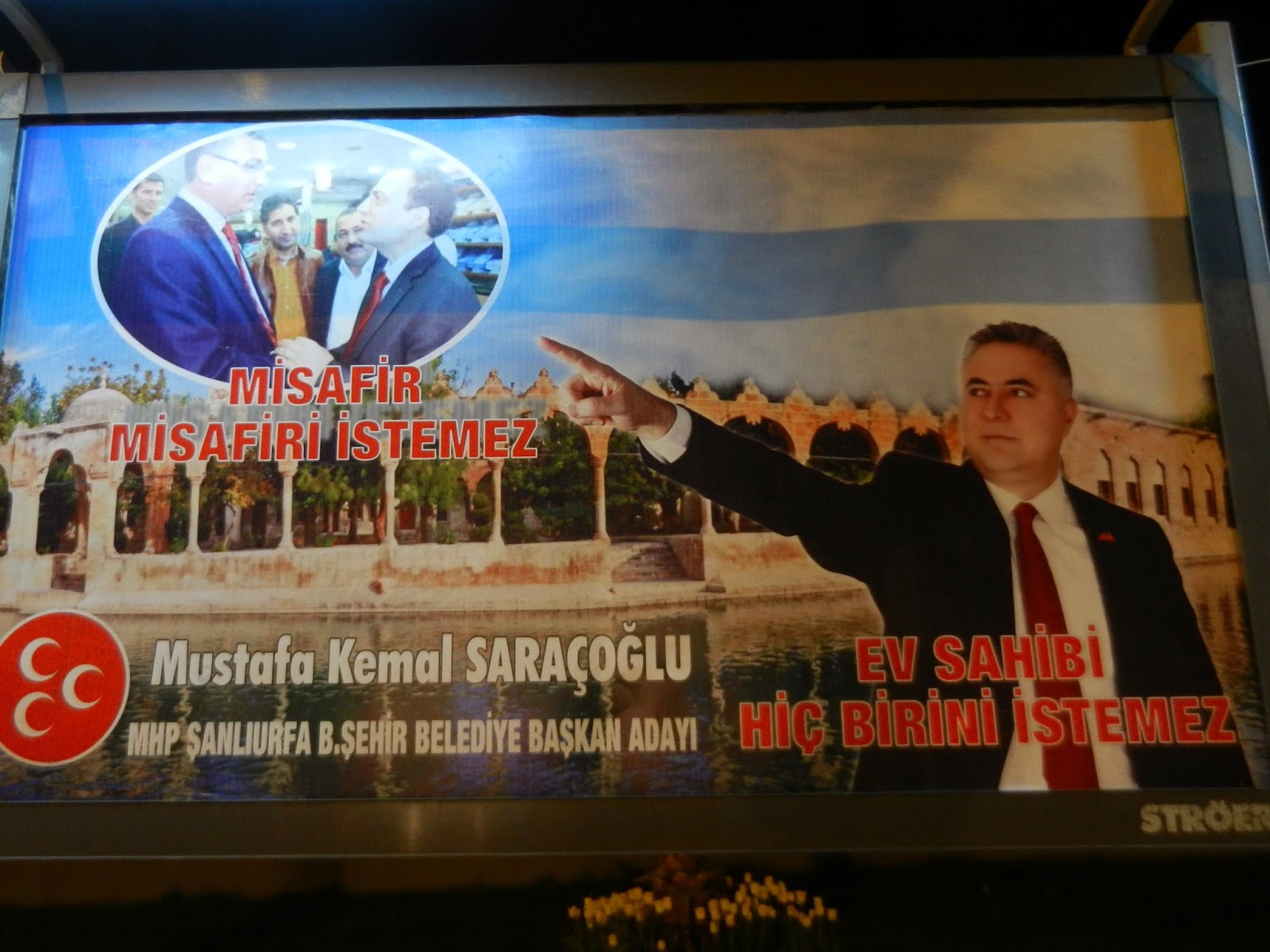
Here a guy points at Osman Baydemir's face and says something like "Guests are unwanted."

This is about the fact that Osman Baydemir is not from Urfa. He's from Diyarbakir. He's actually Diyarbakir's current mayor.

"The homeowner doesn't ask for anyone," is my rough translation of the second part in red.

Would we expect anything else from the Nationalist Movement Party?

11. This guy has never smiled

He's the leader of the Nationalist Movement Party. He gives me the creeps. I only include him because he's been on TV a lot recently. He has a lot of negativity toward Erdogan, which I find interesting, because it's not just the Left attacking the current administration. Pretty much everyone can and does take the moral high ground these days, after the AK Party's corruption scandals.


12. I trust you, Sanliurfa

In spite of the scandals and the recent craziness of shutting down Twitter and YouTube, the AK Party is apparently poised to win at least some of the main positions in the election on Sunday. We'll see...

March 25, 2014

Marriage Arrangements in the Hamam

Nerelisin?
Where are you from?

Erkek arkadaşın?
Boyfriend?

Evli misin?
Are you married?

Bekarım. Bakmıyorum.
I'm single. I'm not looking. 

(I don't know if bakmıyorum translates well. Maybe aramıyorum is better; 'I'm not searching')

Later I am sitting on a marble slab, waiting to be scrubbed and massaged. One woman insists on pursuing the conversation.

Isveçli something something.

No, I'm not Swedish. I'm Canadian.

O Isveçli something something.

He's Swedish? Then how did you meet?

Kocamın kardeş something something.

[I will skip past the part when I confuse koca (husband) and hoca (teacher).]

Wait. He's your husband's brother? Then how is he Swedish?

O Isveçli something something istiyor. Sarı saç, mavi gözlü...

[Internal speech:] Oh, now I understand. He wants to marry a Swedish girl with blonde hair and blue eyes. Never mind that I'm not Swedish and I don't have blonde hair or blue eyes. Hey, we're all the same.

Kanada'ya döneyeceğim.
I'm going back to Canada.

O gelsin.
He can come.

Bakmıyorum, ama teşekkür ederim.
I'm not looking, but thank you (hand to heart, a gesture that has become a reflex).

Kaç yaşındasın?
How old are you?

28.

He is 29.

Ok.

Giyindikten sonra, biz fotoğraf çekebilir miyiz?
After we get dressed, can we take a picture?

Ok.

I make a point of leaving quickly and escape without a photo. 

In guide books, I believe I have read about how back in the day women used hamams to seek out potential brides for their sons, or in theory older sisters for their younger brothers. Umm... it's still happening.

March 10, 2014

Life these days


practicing the local archeological tour / key words: "flint" "adobe" "Roman baths"

Work

Basically, I'm teaching English to villagers who live along a ten day walking path in southeastern Turkey. The goal is that they can better communicate with tourists who come for the path, offering home stay experiences and walking tours.

Money going straight to villagers; the chance to promote other local projects like tree planting, dental health, and primary education; the possibility of real cultural exchange instead of just a tourism service–it's all pretty good.

Walking on the Plains

One nice thing about my work (ok, there are many) is that I can actually walk on the path.

17 km walk to work, from one village to another
a temple several thousand years old

Walking here is obviously very different from hiking in British Columbia. (Notice I can't even call it hiking). There are no mountains, you interact with farmers and shepherds along the way, and you are constantly reminded of past humans. It's just a different experience.

"Local, organic"

Everyone I work with has fields, gardens, orchards, and/or animals. Fresh eggs, homemade yogurt, home cured olives, local bulgur, dried eggplants, tomatoes, and peppers–all have been sent home with me. We roll rice in grape leaves picked in the summer, make salads with pomegranate syrup from the trees out back, and the bread is made from wheat grown in the fields and processed at the town mill.

Social life

In the end, though, I'm not a villager in southeastern Turkey. I don't have three kids already, for example. So I'm pretty stoked to have found in Urfa a small but groovy community of like-minded, equally childless people. And even a climbing gym.


Life is full these days, and time is flowing like water, as they say here. (su gibi geçer)

You can tell that there was a photo-savvy visitor in town. Thank you, Jakob.

February 5, 2014

"Glorious" Urfa Walkabout

You've seen my home. Now, the city!


These girls are rocking a pretty standard Urfa outfit for their age, based on what I've seen: slim jeans, coat to low thigh, and fancy headscarf tied around the front of the neck.


Urfa is no village. Population is estimated at 500,000.


Standard urban Turkish man garb: leather jacket, nice jeans, a longer coat for the gentleman.


In Urfa, by the way, every park is Dude Chilling Park.


Local elections are coming up (more on this later), so the streets are full of signs, flags, and music-blaring vans.


Many of the older women wear long coats, again with the fancy headscarves tied around the front of the neck.


Kitap means 'book' (in Turkish and Arabic). The university students inside were super kind and searched the shelves for a book in English (no dice). One of them, insisting that we speak in English, asked, "What are you doing...here...in Urfa?" I laughed.


Big plaza undergoing development. Requisite Atatürk statue at back left.


Şanlıurfa is the real name of the city. Şanlı meaning 'Glorious' was added to 'Urfa' to commemorate the city's efforts in the War of Independence–the war after World War I, when Atatürk fought off the Allies and made Turkey from what was left of the Ottoman Empire.

Apparently it took a few years of petitioning for the 'Glorious' to be added. Local politicians were tired of hearing about neighbouring cities 'Gazi' (veteran/warrior) Antep and 'Kahraman' (Heroic) Maraş.


Sunny days, cold nights.


Balıklı Göl! "Fish Pond"! This beautiful pool is Urfa's main attraction.


The story: Nimrod pushed Abraham/Ibrahim off a cliff and into a bed of burning embers.


God/Allah turned the bed of burning embers into a pool of friendly fish, and Abraham/Ibrahim went on to play his founding role in the three major monotheistic religions.


And Urfa has a swell park.


In the afternoon I returned to my neighbourhood in Yeni Şehir (New City), and took a walk through a more modest, but still lovely, park.


I like that beyond this empty lot we can see the plains. This is Mesopotamia, birthplace of agriculture! So cool.