Showing posts with label Turkish. Show all posts

May 5, 2022

Spring & monastery: a common word?

One of my favourite words in Turkish is bahar, the season of spring. It can also mean blossom. I know a few women lucky to have Bahar as their name. 

I was idly searching for more background about the word, when a sentence jumped out at me, claiming that bahar in Persian also means monastery. Apparently it came from Sanskrit vihar.

Spring and monastery. How delightful. Imagine a common word root growing out to a time of flowers, colour, and freshness, and to a place of balance, beauty, and spiritual refreshment.

Alas.

Turkish bahar is not related to Sanskrit vihar. At least not in any way I can find.

A Wikipedia article at this time of writing still maintains that there is a connection. I found no evidence to back it up. 

Archeology and transliteration

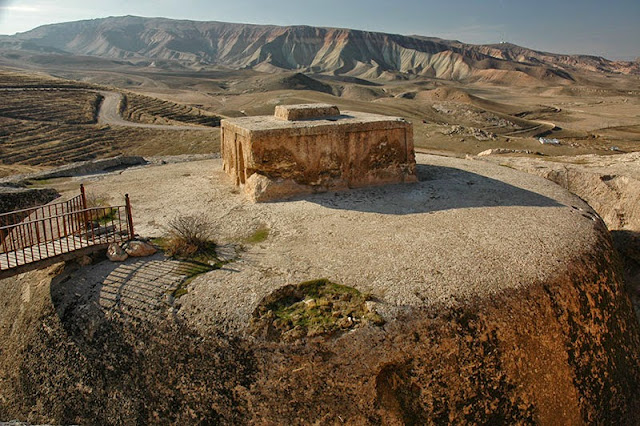
The confusion may originate here: an ancient Buddhist monastery complex in northern Afghanistan.

The monastery is known as Nava Vihāra, or New Monastery. Great. Here is where things get interesting for anyone who cares about transliteration, the art of translating alphabets.

In Sanskrit, this is written as नवविहार. 

With a basic Googled Sanskrit alphabet, you can transliterate this and sound out the word, going left to right. Something like "Na-va Va-ha-ra". I had never worked with Sanskrit, so this was a fun little exercise. I think the scythe shape in the middle divides the two words.

In Persian, it's written as نوبهار‎. 

The Arabic alphabet is close enough for me to be able to muddle my way, right to left: "Now Behar". Hmm. Here is where I think internet knowledge went astray. B and V often get mixed up. I have known many Spanish speakers who struggle with the distinction in English. 

In Persian, I read, you cannot start a new word with the و, which can be sounded as 'v' 'w' or 'oo'. So, instead of writing it as "Now Vehar", a Persian speaker heard the name and wrote it down as "Now Behar." And then people got poetic about vihar and bahar.

I understand the desire to connect. A woman once suggested that çok in Turkish (meaning 'a lot') related to the English expression 'chock-a-block.' I felt embarrassed for her ignorance. Then I was the one who went around telling people that computer in Turkish was 'information palace' (sayar vs. saray being my mistake).

Language facts are beautiful enough without us making them up, poetic as the possibilities may be.

Image source: Okar Research Blog

December 12, 2014

Wiki Friday: Akkadian sense of time

In 2008 I rode a train to eastern Turkey in a backward-facing seat.

I had read somewhere about a people in history thinking of time this way–that we go backward into the future. It makes sense: We can face the past. We can see all that has happened. The future is what we cannot see.

This moment on the train had a lot of juice. I was simultaneously traveling into my own unknown future and into known human past–the origin land of Mesopotamia–with my physical body in a position that encapsulated an ancient sense of time.

Anyway, I mentioned this event to Jordan in 2012. With her memory for all things poetic, she held onto it, and pulled it back out this week. She found this academic article that identifies the Akkadians as the backward-time-thinkers.

Basically, all their words for “earlier” and “past” are related to “front” or “face” (the words are pana, panu, pani, etc.), and all their words for “later” and “future” are related to “behind” (arka, arki, arku, etc.)

The Turkish word for “back” or “behind” is arka, which obviously thrills me.

My heard hurts when I verbally pair the ideas of “later” and “behind.”

As the article author writes, “the mental world of our own modern society” is exactly the opposite that of the Akkadians. “When we look ‘into the future,’ we firmly believe that our gaze is fixed straight ahead. Nothing can shake our conviction that the past is at our back, that it lies behind us.”

Look ahead
Look into the future
Foresee
Look at the week ahead
Forward-looking
Future-facing

Look back at the past
Return to a point in history


Fittingly, that train in 2008 was carrying me toward the land controlled by the Akkadians, in their height around 2200 BC, land which is now Syria, Iraq, Iran, and Turkey. Thanks for the reminder, dear Jordan.

June 9, 2014

Names

canım benim          my darling/ my dear/ my spirit

yavrum          my little baby animal

aslanım benim         my lion

hanım kızım          Miss my girl

Merve / Maryam

These are the names that my 75 year old Turkish granny/supervisor calls me while we are working in the mulberry orchard. It's kind of awesome.

May 24, 2014

That awkward phase of vocabulary learning


in which you know 'bad' words, but can't rely on yourself not to mix them up with other words

boşaltmak (to empty) and boşanmak (to divorce)

These words I know and want to use, but they are momentarily far too risky to try, because I may well open my mouth and say

boşalmak (to ejaculate)

May 9, 2014

So...

The other night someone called me out on my use of o zaman.

He was like, "What is it in English?" "What do you think you're translating?"

I have asked students and non-native speakers exactly the same questions, when they are using a word in a strange way or simply overusing it. 

In my head, o zaman is the perfect expression, and can be used in the following ways:

Tamam o zaman                        OK then
bla bla blah, o zaman....            bla bla bla, so / therefore / as a result / in that case...
O zaman, senin fikrin nedir?     So, what do you think?
O zaman, ne yapacaksın?          So, what are you going to do?

The first usage is probably ok. The second one could or should be replaced with o yüzden or böyle or a bunch of other options. The third and fourth are apparently just unnecessary. Drop the o zaman altogether.

But then we get into idiolect, the individual use of a language. In English, I say "so" a lot. More than most people. Especially when I am teaching. "Ok, so..." is an expression that students have actually made fun of me for. 

O zaman... at the end of the day, there will of course be some compromise. I will probably continue to use this expression more than most Turkish speakers, and in slightly inappropriate ways, but I'll use it less than I did last week.

April 14, 2014

My favourite text message


Güvercinler benimle istanbula gelecekler.

The pigeons will come with me to Istanbul.

March 26, 2014

Yeah, it is hard, actually


Qué clase de amigo?
What kind of friend?

Sí, es mi marido!
Yes, he's my husband!

Hijo de puta!
Son of a bitch!

I thought it would be hard to watch Head-On dubbed in Spanish. (I failed to find the second half with English subtitles, or even just in the original German and Turkish). Instead, to my dismay, watching the movie in Spanish was easy.

I haven't spoken Spanish in years, and I used it for less than a year in total, but I could follow the conversations just fine.

Wah. I've been living in Turkey for four months now, and basic phone conversations in Turkish still scare me. I can't follow native speakers when they talk together. I can't enjoy a local movie. I can barely read news headlines.

I generally espouse the beauty of Turkish grammar, the clean lines of its pronunciation, and the memorability of its words. When people say, "Oh, Turkish is so hard!" I quickly point out that it uses the same alphabet at English and that it lacks almost any exceptions (screw you, French). I don't like to succumb to the weary intonation: "Turkish is hard."

But, yeah, it is hard, actually.

March 20, 2014

to sow / to sew


The first time I learned dikmek was on a farm, in reference to planting roses in the ground.

Later I popped my head into a shop that was obviously concerned with leather, to ask if they had wax for leather shoes. "No, sorry, here we're only dikiyoruz." Here we're only stitching leather.

So dikmek can mean to sow.

And dikmek can mean to sew.

Huh. I never thought about these English homonyms as possible brothers in meaning. To push something down into something else.

I just looked up the etymology of the two English words, though, and they are not as linked as I had hoped.

Ah well. Language learning is mostly a private pleasure anyway, so you can enjoy whatever you want, including moments of "Huh" when you reconsider things in your first language.

March 6, 2014

btw, it's 'first blossom'


'Spring' in Turkish is ilk bahar.

Which translates to 'first blossom'. Yet another reason to love this language.

Winter is over. Happy ilk bahar!

(Thank you Jakob for the beautiful photo)

February 28, 2014

Atatürk on the dolmuş


He really is everywhere still. I love this poster, not only for the chance to practice the passive, but also because it is so extravagant in its adulation.


"There is no army" they said
"IT WILL BE ESTABLISHED" he said

"There is no money" they said
"IT WILL BE FOUND" he said

"The enemy is many" they said
"THEY WILL BE DEFEATED" he said

AND HE DID WHAT HE SAID
(I'm not 100% sure on translating this line's grammar)

AND THUS THIS REPUBLIC WAS FOUNDED

February 17, 2014

Learned last night: NGO, equal, opium

Last night I sat with a new acquaintance and talked about work and religion and philosophy, mostly in simplified Turkish. As we talked, my notebook filled with diagrams and new words.


I like these notes because they take me back to moments in the conversation.


They also remind me that language learning can be messy and chaotic.


I still have no conclusions about any "best way" to learn and retain new vocabulary (or a new language in general), but one thing I'll try now is this: instead of reviewing all the words I learn from interactions with people, I'll extract the ones that I especially want to remember, and spend a moment thinking about them.

Expressions I want to remember from last night


basra körfezi          Persian Gulf

I have no special connection to remember 'basra', but I just spent enough time on the Wikipedia page on the the naming dispute (Arabian Gulf vs. Persian Gulf) while mentally chanting 'basra körfezi' that it should stick.

eşit          equal

They both start with 'e'.  means 'partner' 'husband' 'spouse' 'wife', which suggests a nice association between relationship partners and equality.

destek          support

I just spent time looking up 'to support' (destek olmak), and that time, combined with a feeling of familiarity, makes me think the word will stick. I'm reminded of the experiment that found that people's brains 'light up' when they see faces that they can later identify; in that initial moment, it seems, your brain decides whether it will remember or not. Destek elicited a 'yes' (though we'll see if I can recall it later).

Note: I would love to find a site that does Turkish etymology for English speakers.

sivil toplam kuruluşu (STK)         NGO

'civil' is easy. toplamak means 'to gather' 'to collect'. kuruluşu can be 'foundation' 'organization'. Hmm... maybe if I remember the acronym (STK–'seh teh kah'). Like, 'stick'. An NGO 'sticks' up for people. That'll do.

imge          image

Too easy.

Haziran (June)         Temmuz (July)

I always confuse these two. Now my method is simple: 'h' comes before 't'. This is the same method for remembering that çarşamba (Wednesday) comes before perşembe (Thursday).

hikâye          story

This word I know, but I need to stop adding a 't' to the end. Something I learned in Arabic?

afyon          opium

We were talking about 'the opiate of the masses'. This is such a great word. My brain definitely lit up with the 'this will be remembered' light. Afyon. Afyon.

bağ          connection

I learned this before, but kept confusing the ending.

samimi          sincere, warm

This came up a few days ago when I was describing my brother. Another nice word.

Enough for now!

February 14, 2014

Vocabulary from all directions and a question

Hanging out in a village


yavru          baby animal, e.g. lamb
civciv          baby chick (yeah, cutest word ever, pronounced 'jeevjeev')
şam hurma          'sun date'? does anyone know what this is in English?
koyun        sheep
çoban          shepherd
kavun           melon
tohum          seed (also the word for semen/sperm)
yaramaz          naughty, useless (applied to children, in my observations)
gelin          bride
düğün          wedding

Having a phone stalker


bilinmeyen numara          unknown number
açma          don't answer your phone (literally, 'don't open')

At some point during the endless calling, I was played a recording that said that if I wanted to meet, I should answer the phone, and if I didn't want to meet, I should not answer the phone. My stalker was overestimating my Turkish comprehension skills, because it took two listenings to understand, by which point I had apparently already indicated I wanted to meet.

Watching a Turkish dizi (ridiculous soap opera)


öldüren tutku          fatal passion
engelli          with obstacles, difficult
sakin ol          calm down
gerçek masallar          true stories

Watching Turkish news


cinayet          murder
üflemek          to blow out (as in, there was a fire, and it 'blew out' the roof)
çatı          roof

Conversing about politics and the upcoming election


adalet          justice
asıl          foundation, base, source

Totally recognizable from Arabic. e.g. My dad is Canadian, welakin min asıl New Zealand (but originally from New Zealand). A word I use way too much in Turkish is aslında (actually, or 'at the source').

çoğul          majority
oy kullanmak          to vote
kabul etmek          to accept
dernek          association
üye          member
acemi          inexperienced
yolsuzluk          abuse, misuse (literally 'way-without-ness')

This last was used to reference the event on December 17th, when dozens of AK Party officials were arrested for corruption, money laundering, and bribery. I was in Cappadocia that day, and my Turkish friend there bought a stack of newspapers including this:


Question: How to retain all these new words? 

A friend uses a cool vocabulary quiz app... I used to use paper flash cards... I'm open to ideas.

February 12, 2014

That time I drove to Iraq with a guy named Muslim

Or, A terrible model for intercultural dialogue


Driving along the Turkey-Syria border

Where is Gabriel?


There is some confusion and instead of being picked up by someone I know, I am suddenly alone in a car with a guy named Müslüm, or in English, Muslim. He is thirty-one, with a wife and two kids, and has the habits of smoking in the car and shouting all of his questions.

Do you know Tayyip?


Leaving Urfa, we pass a billboard by the AK Party.

Tayyip tanıyor musun? 
Do you know Tayyip?

Note: If someone asks you if you know the Turkish prime minister and they use his middle name, it might say something about their leaning.

Muslim’s explanation of why he supports “Tayyip”: 

Karayolları? Tayyip yaptı. Hastaneler? Tayyip yaptı  Barajlar? Fabrikalar? Tayyip yaptı. Çiftçiler? Tayyip yardım etti.
The highways? Tayyip made them. The hospitals? Tayyip made them. Dams? Factories? Tayyip made them. The farmers? Tayyip helped them.

“in the middle”


As we drive east, basically along the Syrian border, Muslim elicits that I am not a Muslim. I do my usual song and dance about loving everyone and the importance of being open-minded. 

Ortasındasın or ortadasın, he says.
You are in the middle.

Hmm. Does this mean agnostic? Undecided? I can get the literal meaning, but not the connotations. I shrug my shoulders.

I can never remember how to pronounce ‘proselytize’


Muslim feels that our six hour car ride is an excellent opportunity for me to learn more about Islam, and invites me to ask questions. We review the five pillars of Islam (fasting, pilgrimage, prayers, alms, and saying God is the one God and Mohammed is his messenger), we talk a little about the Turkish women who don’t cover their heads (he’s not supportive), and then somehow he veers into Israel’s tyranny (zulüm), the American invasion of Iraq, and the joint Israeli-American conspiracy to break up Turkey and steal all of its resources. Whereupon I lose my patience and curse in English for a bit before reverting into a messy stream of Turkish along the lines of:

Yeter! Herkes aynı şey bana söyliyor! Her zaman aynı şey! Sıkıldım. Biliyorum. Başka şeyler! Yeter!”
Enough! Everyone tells me the same thing! It’s always the same thing! I’m bored. I know. Other things! Enough!

I’m annoyed that he wants me to learn about his faith, but he has no interest in my beliefs. I’m annoyed that he seems totally fixed-minded. I’m annoyed that he is sticking to the same politicized talking points that I have heard before.

Mountains


After some silence, in the spirit of reconciliation, I point out the mountains in front of us. 

Dağlar güzel. 
The mountains are beautiful. [And they are. After the plains, they are a true relief.]

Ne?
What?

Dağlar, I say again, slowly, gesturing at the mountains.

Ah! daGKHlar.

Evet, daGKHlar!

And this, my friends, is me being a real jerk and pointing out someone’s non-standard Turkish accent. Yeah. I have a lot of thoughts around accent and emotional response, but for now let me just explain that here in the southeast, people tend to replace "standard" (I know, problematic) Turkish sounds like k (pronounced as you’d expect) and ğ (actually a silent letter that extends the preceding vowel) with sounds that remind me of Arabic, such as ‘kh’ (the phlegm cough’), ‘g’ (the gargle), and ‘q’ (the choking on water). Something about this replacement generally disturbs me, and in this unhappy moment, I act out.

Sorry


Pardon. Çok özür dilerim.
Sorry. I’m really sorry.

I apologize for being so edgy (sinirli) and angry (kızgın). I’m tired (yoruldum). It’s my first week more or less living in Turkish. I can’t speak enough. I can’t understand enough. My brain is mixed up (karışık).

Peace in the car, peace in the world


There’s a famous saying attributed to Atatürk, founder of the Turkish state:

Peace at home, peace in the world.

Half the reason I learn languages is to make awkward jokes in them, and here is my chance:

Arabada barış, dünyada barış.
Peace in the car, peace in the world.

Muslim gets it and laughs.

Trucks waiting (up two 2 weeks!) to enter Iraq

Do you speak English?


The Iraqi border guards must not see many New Zealanders, because they ask me if I speak English.

“Ah... yes.”

“Do you want tea?”

“Umm... no thanks.”

“Enjoy your visit in Kurdistan!”

“Thank you!”

What’s your favourite food?


Having established the limits of my Turkish and the danger zones of conversation, Muslim and I spend our evening in the easy and safe territory of food. His favourite is lahmacun (like a thin crustless pizza). I gush about how much I like the soups (çorbalar) and the breakfasts (kahvaltılar) here. He kindly encourages me to eat more tavuk (chicken).

In the morning, Muslim buys us kaymak and bal (butter and honey). I eat literally a dish of butter. We drive back to the border to pass into Turkey. When the guard stamps our passports, the mood in the car shifts to pleasant and mellow. The sun slowly moves down the windshield. We put on sunglasses. Muslim seems to have figured out that he doesn’t need to shout at me, and that it helps to speak slowly.

In Zakho, Iraq

Some are afraid


He asks what people in Canada, America, and Europe think about Muslims. Hmm. I talk about the multicultural cities I have seen and the fact that I have many Muslim friends.

Ama... bazılar korkuyorlar.
But... some are afraid, I admit.

I say that in Canada sports are an important part of my life. I do them in shorts with my hair uncovered, and I cannot imagine giving up this way of life. Likewise, a lot of people in the Western world value their ways of life. They're afraid you would want to change those ways.

Somehow I master an “if” clause to summarize:

Eğer sen beni değiştirmek istiyorsan, rahat olamam.
If you want to change me, then I can’t be comfortable.

His response: 

Ben seni degistirmek istiyorum.
I do want to change you.

Ha. Well where do we go from there? Philosophically, I don’t think we can have real dialogue if we sit down with the intention of changing the other person’s mind.

In these moments I feel the temptation to abandon my faith that people can always change. I see why so  many Westerners accept the “just don’t talk about anything important” approach to multiculturalism.

Ama... arada bir... ?


Somehow we move on to my love life. When was my last sevgili (sweetheart)? Am I seeing anyone now? I say that my life is plenty full with learning Turkish.

Ama... arada bir?

Muslim turns on the overhead light so I can locate my little yellow dictionary. Arada bir... arada bir... so much suspense... Ah ha.

“But... once in a while?”

I laugh and laugh. Then I keep laughing. After the strain of speaking in a second language about delicate matters, it’s a pleasure just to laugh about coarse matters. But if Muslim thinks I am sharing anything, after we reviewed all the things that are haram (forbidden in Islam), including new vocabulary item zina (adultery/fornication, which gives Xena the Warrior Princess a new association), he is quite mistaken.

My laughter fills the car as he mimics cutting off his left hand.

I go my way, you go yours


Muslim drops me off in my neighbourhood. As I walk off into the cool night, I repeat the last thing he said:

Ben yoluma, sen yoluna
I my way, you your way
February 9, 2014

So I guess I'm learning Kurdish

En route to a village where everyone speaks Kurdish but me


I actually came for Arabic


Many moons ago, my friend Melodee sent me by mail an article about bilingual Arabic-Turkish speakers in southeastern Turkey. Sweet, I thought. I've always wanted to go back to that cultural hot spot, and now I can go with the exciting mission of learning Arabic via Turkish. The bilingual Turks can guide me through the daunting underground caves of Arabic, using our shared Turkish as a headlamp.

Şanlıurfa? Sure.


I arrived in Turkey in November with this idea about Arabic in the southeast and also a vision of working in some position that connected to my values–spending time outside, learning and teaching in a human way, and sharing ideas about how to live. By fate, such a position was presented... in Şanlıurfa.

Şanlıurfa, unlike Antakya further south, is not really the city for learning Arabic. Yes, there are Arabic speakers, especially now in the form of displaced people from the conflict in Syria, but the city is primarily Kurdish. I am told that Şanlıurfa is 80% Kurdish, and I believe that means that 80% of people speak Kurdish as a first language.

For instance, many of the people I work with now speak Kurdish as a first language, and Turkish as a close or far second. Turkish ability seems to vary with education, access to Turkish media, and communication with non-Kurdish speakers. These are also the people teaching me Kurdish, using our common second language of Turkish to explain things.

Learning Kurdish via Turkish is probably a huge mistake


Reason 1: The languages are not from the same family. 

Turkish is Turkic. Kurdish is Indo-European. There are some overlapping words, but not that many, based on what I have heard.

Note: Of the two major dialects of Kurdish, I am learning Kurmanji, the northern, versus Sorani, the southern.

Reason 2: The Turkish alphabet sucks at describing Kurdish sounds. 

I began writing Kurdish words with my own made-up transliteration system. Now with the thought that it may be useful in the future, I'm trying to use what Kurdish speakers use in Turkey–the standard Turkish alphabet.

Although no expert after a mere week, I can already tell that letters are missing or inadequate for the sounds of Kurdish. The throaty ‘kh’ that’s similar to Arabic is one thing, as well as a vowel between Turkish ‘e’ and ‘a’.

Kurdish stuff seems to always be political in Turkey, and the inadequate alphabet is no exception. Only last year did the government legalize the use of letters Q, W, and X, [I know–there's a potential satirical Sesame Street episode here] which are used for transliterating Kurdish, but which don’t otherwise exist in Turkish.

See the alphabet issue in this strongly-titled article by a journalist who maintains a devoted blog on Kurdish matters. You can also see the same article written in Turkish and written in Kurdish. [Note to self: Potential learning/self-educating materials].

Kurdish–my long lost cousin?


Learning issues aside, one cool thing about this language is that it feels eerily familiar, like a long lost cousin that shows up with features and mannerisms I know intimately, but wouldn’t notice until someone pointed them out.

Because it is an Indo-European language, and there are so many other Indo-European languages swilling around in my brain in varying quantities (English, Spanish, French, Italian, German, Hindi, Farsi...) every Kurdish word sounds like a possible cognate.

na (no)
du (two)
bra (brother)

Today a woman taught me ba for ‘wind’. It stuck easily. A list of cognates online points out that ba is a cognate for vent (‘wind’ in French). More from the list:

ster (star)
mer (mari in French) (man)
merane (manly)
nu (new)
brusk (blitz in German) (storm)

As my friend Alaina said, it makes the world seem even more like one big family.

February 7, 2014

Learned today: prophet, west coast


iletişim          communication

neyle ilgileniyorsun?          what are you interested in?

Cem Evi          worship place for Alevis

hazreti           his/her holiness

peygamber          prophet

batıda deniz kenarı          west coast

kısas          retaliation/reprisal

Am I searching?

Din?

Religion?

               Ah... çok dindar bir insan değilim.

               Ah... I'm not a very religious person.

               Benim için, herkesi seviyorum... açık olmak önemli bir şey...

               For me, I like everyone... to be open is an important thing...

Oh, hümanist. [My new friend shows her disappointment].

               Yeah, sure. [Is a humanist really the worst thing to be?]

               Ama, dinlere ilgileniyorum!

               But I'm interested in religions! [Is this true? There's a gleam in my interlocutor's eye, in any case.]

somethingsomethingsomething araştır somethingsomething

               Araştır... araştırmak...?

'To search'

               Oh! Am I searching? [The gleam makes sense. My friend is here to help.]

               No... no.

[24 hours later, I am kindly offered a Koran.]

February 6, 2014

Talking Politics


With local elections coming up, and some serious political movement at the federal level, I'm finding it necessary to learn some Turkish vocabulary. Hadi, let's review some old and new.

siyaset / politika          politics


(Siyaset is also Arabic for 'politics.' Or asiyasiya? Maybe that's 'political'? Need an Arabic consult).

hükümet          government


devlet          state


(As is devlet hastanesi, 'state hospital'. When I say that in Canada I teach new immigrants, people always ask I'm employed by the devlet.)

il          province

başkent         capital 


(Baş 'head', kent 'town')

başbakan          prime minister


belediye başkanı          mayor


(Belediye is 'municipality' in Turkish. In Arabic, I think it means country or countryside).

darbe          coup d'état


devrim         revolution


tutucu / muhafazakar          conservative


(The second comes from Arabic. One person said it's not commonly used, but the next day another person used it before tutucu.)

milliyetçi           nationalist


anket          survey


That's enough for now. I suspect Turkish politics are always interesting, but the situation is especially intriguing right now, with a Muslim scholar in Pennsylvania apparently initiating corruption busts, a Prime Minister whose new slogan is "Iron Will", and population that experienced a political awakening this summer.

You can get a grasp of the major plot lines from this great article from New York Times Magazine by Suzy Hansen.

November 21, 2011

The "one country, one language" myth


I dragged my mother to the first annual Vancouver Turkish Film Festival to see this documentary. On the way into the make-shift theatre, a man asked why we had chosen this particular movie.

The synopsis, I said, reminded me of Bahcesaray, a village in Eastern Turkey that I had visited for the sake of its name ("Garden Palace"). In this beautifully named village, I had learned a startling truth: Not all Turks speak Turkish, at least not as a first language.

The documentary reminds us of this truth. The pale-skinned, silver watch-wearing, Turkish-speaking teacher from the West is confronted with it when he arrives for his two-year posting at a primary school in the East. Many of his students only speak Kurdish. At once, his task shifts from teaching mathematics and social studies to teaching Turkish.

"He's a language teacher with no language training!" I whispered to my mother partway through.

The title is Iki Dil Bir Bavul ("Two Languages One Suitcase"), but the English title was given as On the Way to School.

June 26, 2011

Nadir


The word is so interesting, and it's come up twice this week.

I asked Afsaneh how to say, "No problem" in Farsi. The answer, though I am surely transcribing it with mistakes, is something like "Moshkeli nadire" (MOSH-KAY-LEE NAD-DEE-RAY). This made easy sense, because both the words are familiar.

"Mafi moshkela" we used to say in Saudi, for "No problem."

"Nadir" is "rare" in Turkish.

Then, yesterday, Robin asked for the opposite of "zenith." He was fishing around for a word that he already knew. "Nadir," I put forward, "but it's an Arabic word, I think." "No, that's it!" And so it is. "Nadir" is English for the direction pointing directly below something. It can also work like "trough" or "bottom." Such words are almost invisible, they are so rarely used. Likewise, the spiderweb connections between languages often go unnoticed.

"Nadir" comes from the Arabic نَظِيرُ السَّمْت, nadhir as-samt, "counterpart to the zenith".

May 31, 2011

Love is a bowel movement


"Sevgi emekmiş"

Can Yücel writes in his poem, "Anladım."

"Emek" is Turkish for something like "effort." Nesli and I searched synonyms for "effort." A huge list appeared: attempt, endeavour, feat, effort, campaign, exertion... bowel movement.

I explained and we laughed for a long time. Sure, love is a bowel movement.