May 6, 2025

Is social media dead (to me)?

I use Facebook for buying the odd thing or offloading furniture, like the IKEA dresser I got along the way - it turned out to be a baby change table - and the Adirondack chair that came with the house, made of skis of some kind. I got myself off TikTok. I’m still on Instagram, but mostly just to scroll videos, since I got off TikTok. I never really used Twitter, or X.

I remember reading the term “prosumer”. Someone coined it to describe how we all, or most of us anyway, both produce and consume social media. My ratio is way off. I consume and consume.

Producing on Instagram used to be fun, a draw. That’s changed.

Still, that old format, picture and words, like those booklets to fill out in kindergarten, awaits.

Back to blogging?

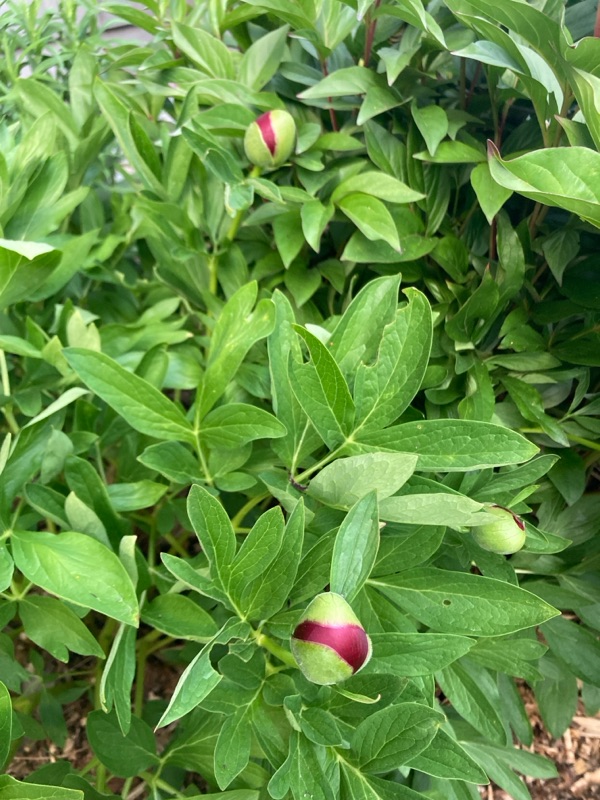
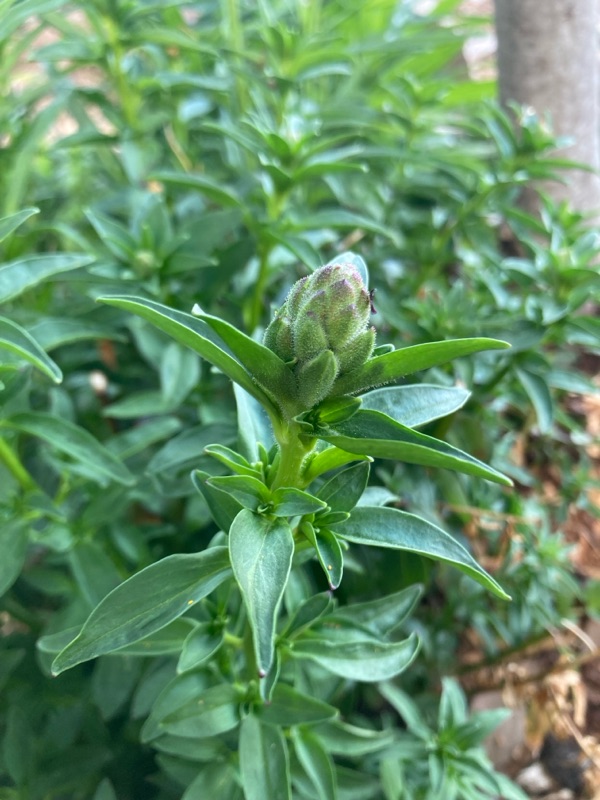
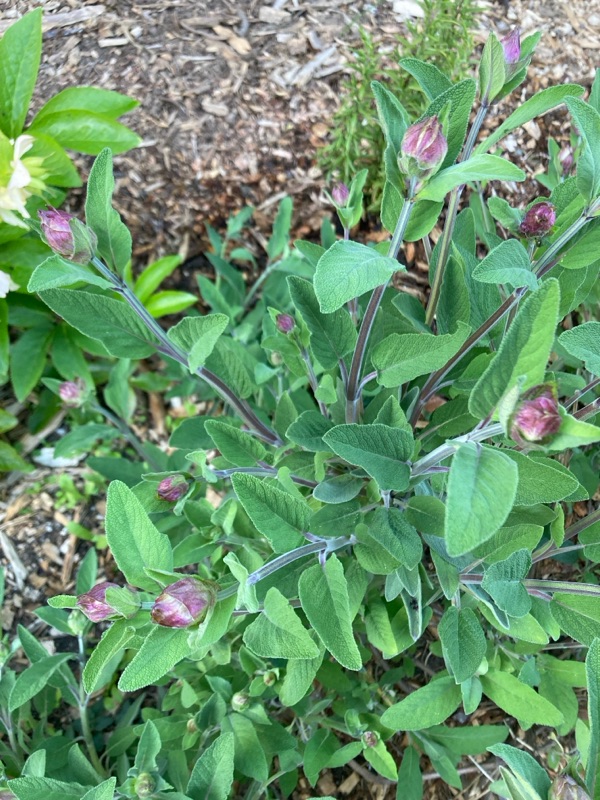
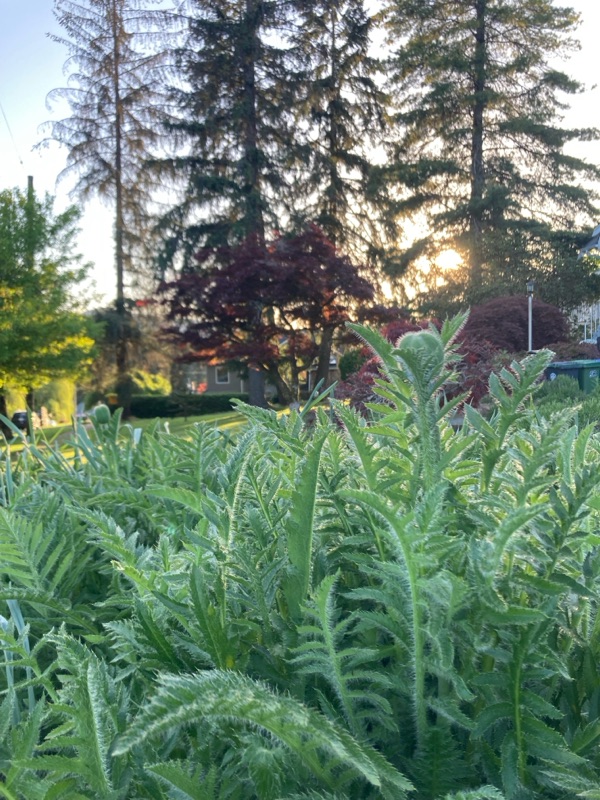
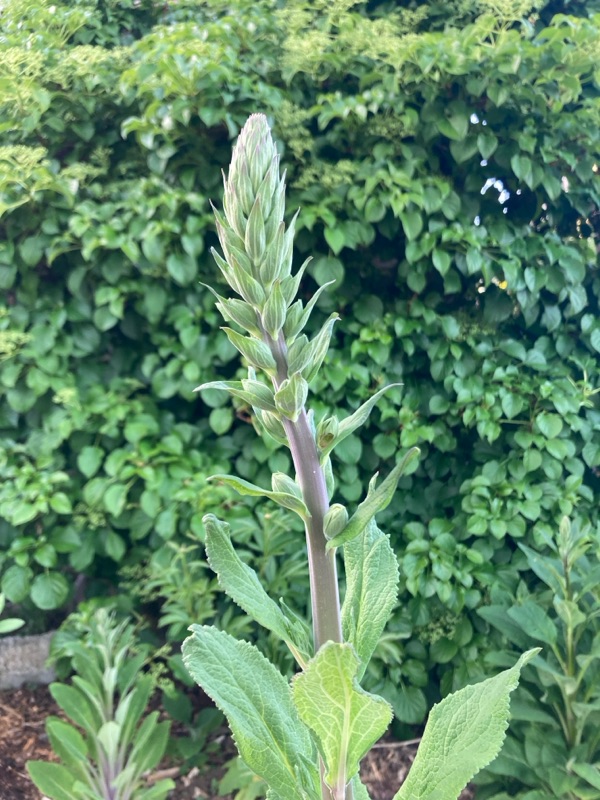
This evening I looked at the almost-flowers in the front garden, and a few already-flowers. How would this micro season be labeled?

foxglove spire

peony peel

snapdragon rears its head

sage in flower

here come the poppies

here comes summer

January 9, 2025

Wiki Friday: "one and the same" or holidays and numbers

December 25th

My favourite suggestion for how the date of Christmas was decided: nine months after Annunciation, i.e. God knocking up Mary, we'll celebrate a child being born. Conveniently coinciding with winter solstice and the Roman festival of Saturnalia.

Saint Nicholas


Early Christian bishop of Greek descent from Patara in Turkiye (I've been to the beach!). He evidently rescued three girls from lives of prostitution by... dropping off presents! Specifically sacks of gold coins through their windows so their fathers could afford their dowries. Ho ho ho. 

Lesser known feats include chopping down a tree possessed by a demon and resurrecting three children murdered and pickled in brine. A painting of Saint Nicholas with the barreled children seems to have been misinterpreted, and has led to Saint Nicholas being adopted as the patron saint of brewers. 

Illustration of Saint Nicolas from the French book "Les Grandes Heures d'Anne de Bretagne" (Grandes Heures of Anne of Brittany in English)

Numbers


Numbers! I'm so interested in numbers! Do numbers exist without humans? What is the deal with representing numbers? Where did words for numbers ("three") come from?

My Wikipedia reading did not exactly answer the questions, but did provide more fodder for thought:

Numerals or symbols are the written or visual representation of numbers. "Number words" came first. We spoke before we wrote. Right.

A raised finger for "one" seems to elemental. "Just one," I say to Maya. "Take one." "Only one". Of course this becomes a tally, become a symbolic slash. The original line. There is some evidence we are neurologically wired to think in numbers with our hands.

Base 8 systems use the spaces between our fingers. Base 12 systems count the segments of our four fingers. There have been base 4 systems, base 5, base 60. Egyptians brought us base 10. 

Did you know that the near-universal system we accept as the norm is called the Hindu-Arabic numeral system?

The mathematician Aryabhata had a system of Sanskrit consonants for small numbers (1-9) and vowels for powers of 10 (10, 100, 1,000). It was discontinued because it made unpronounceable phrases. Just remember we once had such a multiplicity in systems.

The assumed naturalness of math, its neutrality, bothers me. Re-historicize math! How did we get here? To counting to 10? To using a zero? "How can nothing be a thing," was a legitimate debate.

Finally, let us not lose the historical linkages of spirituality and numbers. Numerology influenced Greek mathematical questions. "Medieval computists" had the job of calculating when to celebrate Easter. The Hindu-Arabic numeral system that you and I probably both use has roots in Hindu cosmology, specifically calculating the lifetime of the universe.

Oh, and "one and the same" is a funny phrase when we know that "same" comes from the Proto-Indo European root *sem- meaning "one". We see the root in assemble and assimilate. "One" and "the same" are truly one and the same.

November 2, 2024

Am I into anarchism?

I think so. Thank Urusula Le Guin and her novel The Dispossessed. Here are passages that capture the two planets of comparison:

Odo wrote: “A child free from the guilt of ownership and the burden of economic competition will grow up with the will to do what needs doing and the capacity for joy in doing it. It is useless work that darkens the heart."

[...] There was an undercurrent of joy, in that sense, in Abbenay that summer. There was a lightheartedness at work however hard the work, a readiness to drop all care as soon as what could be done had been done. The old tag of “solidarity” had come alive again. There is exhilaration in finding that the bond is stronger, after all, than all that tries the bond. (247)

vs.

Everyone was very polite and talked a great deal, but not about anything interesting; and they smiled so much they looked anxious. But their clothes were gorgeous, indeed they seemed to put all the lightheartedness their manner lacked into their clothes, and their food, and all the different things they drank, and the lavish furnishings and ornaments of the rooms in the palaces where the receptions were held. (83)

September 16, 2024

Wiki Friday: criminalized colour schemes, bonsai kittens, and more

Where to even begin. I guess with hello. It's nice to be back. Nice to be writing a Wiki Friday.

Today is the first day my daughter is in daycare. She's barely there for a few hours, but wow, the spaciousness I feel in this toddler-free home. Even with a head cold I can imagine, for the first time in a while, completing the writing process involved in a Wiki Friday. 

Composing Wiki Fridays is, believe it or not, one of my great joys. I haven't read Thinking, Fast and Slow, by Daniel Kahneman, but I think I get the gist. Most day to day activities, these days anyway, ask us to think quickly, to give opinions quickly, to react quickly. Thinking slowly, deliberately, while living with a smart phone strapped to one's hand, seems nigh impossible. Pausing from reacting, to pursue my own line of inquiry, is a true refreshment to my mind and spirit. Let us begin.

Red, yellow, green – a criminalized colour scheme


The book Gardens of Water, by Alan Drew, had been sitting on my shelf for years. I knew the novel was set near Istanbul after the devastating 1999 earthquake, but I guess I hadn't read it through to the end. It's quite gripping, and really goes deep with the perspectives of different characters, from a Kurdish teenage girl to an American father who can't resist proselytization. In one plot point, a Kurdish boy in Eastern Turkey is shot by the Turkish military because he appears to be wearing red, yellow, and green, which make up the colours of the Kurdish flag, above. 

Folks on the internet debate whether this colour scheme, or the flag itself, is technically illegal or banned in Turkey, but suffice it to say, the colours have been dangerous for many. I am personally drawn toward red, yellow, and green, in art and nature, and as a result have been thinking about these colours together a lot. As we go into fall in the northern hemisphere, we will see them everywhere, in berries, leaves, dried grasses, and vegetation made lush by rain. Perhaps more on this another time.

Grapes


This search was generated by the fact that I couldn't picture grapes vines having flowers. But as with all fruits, they do flower. The flowers are just small.

While scanning the Wikipedia pages, I learned that Concord grapes are named so because they come from the city in Massachusetts. They were cultivated from wild grapes there by farmer Ephraim Wales Bull. I only tried Concord grapes as an adult, and my first response was, "Oh, this is 'grape flavour'". And indeed it is! Concord grapes spawned an entire industry of grape-flavoured products, from candy to soft drinks.

Bonsai kittens

I tentatively brought up 'kittens in jars' to David. Did he remember this urban legend that was floating around when we were kids? It was an urban legend, right? No one was actually growing kittens in jars to stunt their growth, surely. David looked at me with bemusement. He had never heard of such a thing.

Wikipedia confirms that this was a big hoax around the year 2000. An MIT student created a website that described the "lost art" of bonsai kittens, and the internet, particularly animal rights people on the internet, went nuts. Somehow the hoax even reached me.

Tolkien


Good old J.R.R.

We're watching the news Lord of the Rings: Rings of Power series, or, as I call it, 'Ring TV'.

Maya will be home soon, so I'm just going to share some quick little zingers:

Tolkien worked for the Oxford English Dictionary, on Germanic words starting with W.

We have his mother, Mabel, to thank somewhat, for she homeschooled him, including in botany and Latin.

He was bitten by a large baboon spider as a child.

He served in World War I and it is understood that Mordor is based on scenes from the trenches.

He was very into Beowulf.

In a letter, he said that the purpose of life is to know God and be moved to thanks.

He may have been the first to use the term 'phonoaesthetics', regarding the relative beauty and pleasantness of certain words or sounds within words.


Until next time.
August 23, 2024

The motherbaby


This sculpture at the Art Gallery of Ontario made me think of the idea of the motherbaby, which I had come across in one book explicitly, but in many places implicitly.

July 9, 2024

The end of history

 I’ve never exactly known what this expression referred to.

Wikipedia reassures me that it has been in play at different times and different ways, namely, since the late 1800s and in the fields of history, economics, politics, and culture.

Francis Fukuyama used the term for the title of an essay in 1989 and then a book in 1992, perhaps fixing it more firmly in the minds of many. Apparently he suggests that the end of history, a settling into a single accepted socio-economic framework worldwide, will be a sad time. We won’t be animated by grand, different ideas of a better world. We will just tinker around the edges. 

From what I gather, though, we aren’t there (yet?).


June 16, 2024

The Geography of Memory


Poets are the best at prose. In this case the poet is Jeanne Murray Walker, who wrote a memoir about her mother's years with Alzheimer's and her own memories of a Midwestern, fundamentalist Christian upbringing. I really enjoyed this book, so much that I stayed up way too late multiple nights in a row.

309
She talks about metaphor. Her mother's ("Mother's") speech can be compared to the poetry of surrealists like Pablo Neruda, who "stuff their poems so full of metaphor that it's next to impossible to find a literal meaning." Accept the metaphor. Work with the metaphor.

263
On deciding which items will go with Mother to the care facility: "...I'm horrified by the responsibility of making these choices."

331
When she breaks free from Mother as a teen to travel to Peru: "The steep, husky, endless, snowy mountains gave me vertigo. I felt thrilled by the smallness of my own body and by the way the road ahead dwindled to a gray thread."

343
Watching Mother in a hospital bed after a hip is broken: "Watching is like hearing an alarm wailing, like an arrow slowly going through my heart."

319
A recounted prayer: "Life is short and we do not have much time to gladden the hearts of those who travel with us. So be swift to love, make haste to be kind, live without fear. Your Creator has made you holy, has always protected you, and loves you as a mother. Go in peace and follow the good road and may the blessing of God: Creator, Redeemer and Sanctifier, be with you now and always."

March 7, 2024

Life in third person

Niña

Cuatro y medio 

Casi cinco meses

Tiene cinco meses

Si muy linda

Si ella es muy feliz

No llora mucho

Está durmiendo


January 14, 2024

WikiFriday: Hippos, cortisol


Hippos

Are most related to... 

whales and dolphins! 

They all share a semiaquatic ancestor, and diverged 55 million years ago. Hippos and whales and dolphins. Something in me feels that everyone should learn this.

Cortisol

Is extremely connected to our blood sugar level, which I learned is tightly regulated in the human body. Side rabbit hole: Apparently the average adult human only has about 4 teaspoons of sugar in all of their blood at a given moment.

Contrary to what social media influencers say, cortisol does not cause inflammation. To the contrary, it prevents inflammation. 

It does, however, lead to osteoporosis.

I learned that you cannot say that cortisol suppresses the immune system. It actually triggers a specific immune response.


That's all I've got for now. As always, thanks, Wikipedia.

January 4, 2024

Mansions vs democracy


I’ve been thinking about the intangible damage done by bigger homes. They can erode community within the household by drawing people to separate rooms. At the extreme end, when people have private pools and movie theatres, they can completely obliterate social connections, because residents have no reason to go out and use public services.

And then I think of the book with the thesis that democracy relies on unplanned encounters and common experiences. Mansions vs democracy.

Plus, they are hard to clean.

May 5, 2023

There's no place like blog

 I feel like I have been waiting years for the dust of social media to settle. Would a blog still have relevance?

In slow, quiet moments in class – I’m a substitute teacher these days – I go to two blogs: Cup of Jo and Ann Lovejoy’s garden blog. The first is out of habit. I still like it even though it has commercialized. The second is a more recent addition, born of my increased passion for gardening and the happy discovery that the book author Ann Lovejoy maintains a classic personal blog.

I “go” to these blogs. I “visit” them. But I don't go to Instagram. I don't visit Tik Tok. These are not places, but “platforms”, where photos, videos, symbols, and advertisements wash over me, distract me, pull me. I still have to click away ads on Cup of Jo, it’s true. But as a blog it remains a place, with the familiarity and natural change that define all places.

Yesterday, in a science class, I visited my own blog. What was I doing and thinking in months of May past? I was glad to have a place to go to find at least some answers to the question.

August 6, 2022

All or nothing thinking & language learning


They don’t go together.

Binaries in our minds

I have been thinking about all or nothing thinking, also called black and white thinking. This cognitive distortion seems to go hand in hand with anxiety, perfectionism, corporate culture, and a whole bunch of cultural spheres and overtones. I’ve seen people connect it to white supremacy.

Examples:

“I want a perfect home.”

“Healthy food” versus “junk food”

The idea of a “good mother”

“It’s not worth doing if you don’t do it well.”

“There are only two options: stay together or break up.”

Pushing kids into competitive sports.

“I quit.”

I notice it in myself a lot. It makes me happy when someone punctures the all or nothing bubbles in my mind.

For example, a friend told me she signed up for a dance class because it was in her neighbourhood. Instead of searching the internet and asking around to find the best dance studio, she chose a class at a community centre because it fit into her life. What a reasonable, sustainable act.

I think about that anecdote, and feel freer to choose something, rather than all/the best or nothing.

As KC Davis put it on Tik Tok, “motivation suffocates in all or nothing thinking.” We can make an action seem so big and looming that we forget more accessible, more delightful, options. KC invites people to care for their homes without self-criticism or shame.

I want to invite people into language learning in the same way.

All or nothing thinking in language learning

Unfortunately, totality is embedded in the way we talk about languages.

“Do you speak Spanish?” (binary, all or nothing)

“Do you know Spanish?” (binary, all or nothing)

We try to get around this:

“A little.”

“Some.”

“I’m learning.”

“I used to, but I haven’t practiced in a long time.”

Underlying the question is the idea that it is possible to totally speak or know a language. This is a fallacy! I have reflected on it before, when I noticed I was “learning English”, my native language, during my masters program. 

We are always somewhere in relation to a language.

Another binary: We must be actively learning/studying/improving or we are doing nothing, perhaps even backsliding.

As if that is even possible. The mind is always moving. The environment is always prompting. But when we buy into the all or nothing idea of language learning, motivation is suffocated.

Compare:

“I need to learn Spanish.” (all of it)

Versus:

“Ooh, what is the verb for ‘wonder’?”

Or:

“I want to browse the Wikipedia entry for Spanish, find some weird facts.”

Or:

“I wonder if there is a local Spanish class this fall, maybe in my neighbourhood?”

Let’s not suffocate ourselves. There are always an infinite number of ways and opportunities to learn language.

July 11, 2022

Noticing, in gardens and languages


Once you start to notice something, you notice it more and more, both in plant identification and in language learning.

Some say that this noticing is essential to language learning. It's the key. You can't really learn, or it's hard, if you aren't noticing – whether it's a new word, a recurrent phrase, a strange grammatical ending, or the way people greet each other.

There will be an organic, individual order in which you notice things. You'll focus on one thing now, another thing in a month. Different features of a language will stand out to you more than to another person. Teachers can draw attention to language or even try to elicit noticing. But, inevitably, they will try to teach you things you haven't even wondered about, haven't even encountered.

So, if noticing is essential to learn a language, how does one turn the noticing on? I propose it is natural, if you aren't under duress.

I actually consider attention a marker of well-being. Am I able to pay attention to things outside of myself? Be interested? Not in a vigilant way, of course, where all things are noticed as threats. Sometimes the honest answer is no. I'm too stressed, too anxious, too overwhelmed, too preoccupied with the latest worry. That said, I can often walk myself back into a state of "soft fascination", to use that term from psychology.

The rhythm of walking, the fresh air, the movement through time and space... I begin to see the floppy poppies, the dark-eyed pink rock roses, the blackberry blossoms to return to later. I notice the wind in the familiar, beloved eucalyptus. The season announces itself as chestnuts form from flowers. Walking helps restore my view of the world as a safe and interesting place (thank you, Artist's Way).

Those two poles – safe and interesting – do different things to and for my nervous system. The first offering, "What if there is nothing wrong?" Saying, "You can breathe, you can move, you can look around." The second saying, "Not only that, but there is stuff worth breathing for, walking for, looking around for. Behold the colours and textures."

I think the same world view is useful for learning a language. To be neither drowning nor bored. Try it out. Say: "Learning [French/Spanish/Etc.] is safe and interesting." From this position, you can stand comfortably, as if in front of an abundant garden, and begin to notice. What draws your eye first? What is familiar? What are you most interested in today? You don't need to learn and catalogue everything today, or ever. No one has.

May 5, 2022

Spring & monastery: a common word?

One of my favourite words in Turkish is bahar, the season of spring. It can also mean blossom. I know a few women lucky to have Bahar as their name. 

I was idly searching for more background about the word, when a sentence jumped out at me, claiming that bahar in Persian also means monastery. Apparently it came from Sanskrit vihar.

Spring and monastery. How delightful. Imagine a common word root growing out to a time of flowers, colour, and freshness, and to a place of balance, beauty, and spiritual refreshment.

Alas.

Turkish bahar is not related to Sanskrit vihar. At least not in any way I can find.

A Wikipedia article at this time of writing still maintains that there is a connection. I found no evidence to back it up. 

Archeology and transliteration

The confusion may originate here: an ancient Buddhist monastery complex in northern Afghanistan.

The monastery is known as Nava Vihāra, or New Monastery. Great. Here is where things get interesting for anyone who cares about transliteration, the art of translating alphabets.

In Sanskrit, this is written as नवविहार. 

With a basic Googled Sanskrit alphabet, you can transliterate this and sound out the word, going left to right. Something like "Na-va Va-ha-ra". I had never worked with Sanskrit, so this was a fun little exercise. I think the scythe shape in the middle divides the two words.

In Persian, it's written as نوبهار‎. 

The Arabic alphabet is close enough for me to be able to muddle my way, right to left: "Now Behar". Hmm. Here is where I think internet knowledge went astray. B and V often get mixed up. I have known many Spanish speakers who struggle with the distinction in English. 

In Persian, I read, you cannot start a new word with the و, which can be sounded as 'v' 'w' or 'oo'. So, instead of writing it as "Now Vehar", a Persian speaker heard the name and wrote it down as "Now Behar." And then people got poetic about vihar and bahar.

I understand the desire to connect. A woman once suggested that çok in Turkish (meaning 'a lot') related to the English expression 'chock-a-block.' I felt embarrassed for her ignorance. Then I was the one who went around telling people that computer in Turkish was 'information palace' (sayar vs. saray being my mistake).

Language facts are beautiful enough without us making them up, poetic as the possibilities may be.

Image source: Okar Research Blog

April 6, 2022

A Celtic language in Anatolia


Did you know that in Anatolia, in modern Turkey, people spoke a Celtic language called Galatian?

They did. See that green blob furthest on the right.

History was wasted on me in school. Truly, I didn't appreciate it. Now I listen to the Fall of Civilizations podcast, read biographies of Mohammed and Genghis Khan, and spend hours on Wikipedia trying to get the gist of things.

Thanks to scrolling Wikipedia, I found this tidbit about the Celtic language Galatian. Since Wikipedia has its limitations, I looked to a couple other sources, too.

My major takeaway is that three tribes from Western Europe traveled through the Balkans to Anatolia. The tribes have wonderful names: the Tectosages, Tolistobogii, and Trocmi. Together, members of the tribes ventured east as part of a great Celtic migration in 279 BCE and maintained their language for at least a few hundred years.

Why this little tidbit of history means something to me: I know my ancestry only as the British Isles. To connect those islands with Anatolia, a place I have traveled more extensively and been enlivened by, lights something in me.

I increasingly appreciate history as a study of change. The world changes, changes, changes. What is will not always be. What has been may be again.

In other words, this tidbit dissolves some idea I might have about stasis and isolation. Even thousands of years ago, people traveled, spoke to each other within and across languages, and traded known objects for novel ones. People saw new places and sometimes stayed.

The story of Galatian language also connects to this recurring question: Why do we speak the languages we do?

For example, why do I speak English? Why this English – my specific idiolect – with its current word bank, pronunciation, and ways of construction? Why not a Celtic language?

The answer I imagine as a long story, drawing on trade, politics, war, migration, imperialism, colonialism, economics, landscape, ecology, urbanism, education, philosophy, media, and many more fields.

I wonder if an inquiry approach would have changed my experience of history in school. I doubt I would have posed the questions above. I would have posed a question, though, had someone prompted. And I may have found this inner flame, which guides me to search, read, think, and reflect with so much pleasure.

Sadly researchers have not much found much preserved Galatian language. Mostly people's names. I did read through the names, looking for familiarity, but they seem truly foreign to me.


Additional sources: 2016 university thesis on "The Ethnic Identity and Redefinition of the Galatians in the Hellenistic World"; 2002 review of The Galatian language : a comprehensive survey of the language of the ancient Celts in Greco-Roman Asia Minor.

Image from Wikipedia: By QuartierLatin1968,The Ogre,Dbachmann; derivative work Rob984. - Derived from File:Celts in Europe.png, omission of the early modern stage. Sources for data: See File talk:Celts in Europe.png, CC BY-SA 4.0, https://commons.wikimedia.org/w/index.php?curid=50243888

March 16, 2022

Wiki Friday: books, science, trends


Author of The Salt Path

I was trying to remember it, after enjoying the book so much. Raynor Winn – a memorable name. Her partner goes by Moth. Winn relays the story of walking the coast of England, after the couple have lost all their money and learned that Moth has a degenerative terminal disease. 

How happy I was that the book had been written. I don’t often see travel memoirs from people who are not just trying to save money, but who are truly poor. How is homelessness perceived when people are on a touristic trail, versus in a city? What role does age play?

I was curious if Winn had written another book. Indeed she has — The Wild Silence. From summaries I see it is about life after trauma and rewilding a property. 

More recently, and on that note, I read Wilding by Isabella Tree, which captures the challenges of attempting to return land to a previous state. It makes me think of neo-paganism and the challenges of reconstruction. Looking forward to reading this second book by Winn.

Why is the sky blue

Frequency
Vibration
Oscillation
Scattered light
Blue scatters the most
A reminder that rainbow colours together are white
Why clouds are white
Droplets
Sunsets 
Our chance to see the other colours coming from the sun

Earthworms

I have been walking around and amazing people with the factoid that earthworms were introduced to North America. 

Is this actually true? No. 

Apparently some earthworms are native here. Others have been introduced, and indeed some are considered invasive, especially in forests where they consume fallen leaves which would normally decompose. Species who live all over the world are called peregrine or cosmopolitan earthworms, which is a bit funny.

Honey bees

Honey bees defending their hive by swarming two hornets; the heat they generate can kill

Okay, this factoid really is accurate:

No honey bees lived in North America during human times until introduced by Europeans. 

I learned that of the 20,000 bee species alive today, only 8 are honey bees. 

Slow Food 

McDonalds resistance
Bra (the town)
Carlo Petrini, now 72, contributing culinary articles to communist newspapers
Turin/Torino
Terra Madre Salone del Gusto
Should I learn Italian?
Critiques of elitism
Alice Waters
Turkey

November 22, 2021

Wikifriday: Gas and levees

When I searched "levee". Photo by Justin Wilkens on Unsplash


Where does B.C.’s gasoline come from?


Well, this is news to me. 


Most of our province’s gasoline comes from Alberta via the Trans Mountain pipeline. Some is also produced by B.C.’s two refineries in Prince George and Burnaby. Less than 10% comes from U.S. Pacific Northwest, via ship, barge, and rail. 


And Vancouver Island specifically? Barges to Nanaimo from mainland B.C. and Washington state. 


I went down a few Wikipedia holes and Twitter holes in researching this, including Dan McTeague’s Wikipedia page, which references both 50 Cent and Henry Morgentaler. But we have other questions to answer today.


Canada Energy Regulator

Vancouver Sun

Capital Daily

CTV


Where do chickens come from?


Southeastern Asia.

I thought so, just wanted to check.

Apparently chickens were used for cockfighting and special ceremonies before they were kept for food.

Wikipedia


Dike vs dam vs levee


Dam is easy: a barrier that cuts across a body of water, with the result that water is on both sides.

Dike and Levee are a little more nuanced. One source argues that a dike holds back water from a place that would normally be submerged, while a levee protects an area that would normally be dry. Wikipedia indicates that it’s more of a linguistic variation: Levee coming from French levée (lifted), and spreading from French speakers in New Orleans into North American English. Dike coming from the Dutch word dijk. 

Interestingly, to me anyway, dike comes from the PIE (Proto Indo European) root *deighw-, “to stick, fix”, which gives us ditch and dig. Turkish is from a different language family, but I can’t help by think about the word dikmek, which means both ‘to sew’ and ‘to sow.’ 

Online Etymology Dictionary
WOCATpedia
Encyclopedia Brittanica

Mar Street

Where did our street in Port Alberni get its name? I don’t know. But I have reached out to the Port Alberni Museum’s Collections Coordinator. 

Happy Sunday, everyone.

November 12, 2021

Time and school


Woods in Port Alberni, Nuu-chah-nulth territory
Report published in 1996

This section from Indian Residential Schools: The Nuu-chah-nulth Experience struck me:

People on the coast are very aware of the seasons and refer to that daily so it’s now herring season, then it’s cod season, then sealing time, then spring salmon time or it’s berry picking season, or cedar stripping season, or it’s the time to go out and dig clams, so a sensible awareness of season is central to the way we live, and to Nuu-chah-nulth ways of looking at the world. To be taken from that and to have to live in a place where seasons were irrelevant and it's snowing outside while you go outside and play at 3:30-4:30 if it’s raining outside then you go out and play at 3:30-4:30 and if it’s a blistering hot day then you go out to play from 3:30-4:30 and when the bell rings regardless of what the weather is doing Sumer, Winter, Spring and Fall you hop to get in your lines and march in for supper, that alteration in the way we perceive the world relevant to time is real significant loss of culture.


People in traditionally Nuu-chah-nulth culture make time for other people who have a need when they can. They make time when they can to help when others have work that needs to be done that requires more than just their own effort. People make time to help others who are in pain when there is a loss in a family or there’s trouble with someone that’s extremely sick and so on. Other people pitch in and help out that sense of time, our time being important and that we use our time to benefit our own family and other families around us to support village life, that sense of time went out the window when children went to Residential school and they began to live by bells and whistles, line up and get into the school and line up and go to the chapel and pray and line up and go have your shower and stand by your bed at attention till the bell rings, then go to bed, the bell rings get up. That change in the sense of time was very dramatic and I don’t think that it changed over time, I think that it was dramatic for people in 1900, I think it was dramatic for people in 1940 and in 1970. The sense that our time doesn’t belong to our family, isn’t there for our family to benefit from, or for us to benefit from changed so that our time is there at the disposal of people in authority. 


You did each of the other activities because someone else set down your blocks of time and lots of times students had a very hard time in school because they knew it was time to be doing something and they weren’t able to be doing it. All they were able to do is go to class.

These reflections on time exist in the chapter Loss of Native Culture. Sense of time, or changed sense of time, appears again in the next chapter, Going Back Home.

In all cases, no village on the coast operated on school time, or operated around the kinds of timetables that students were used to in Residential school. So, often time, they thought that things were un-organized, disorganized, not really very well plotted out, or that the lack of minute-to-minute plan represented the fact that people were stupid, were dumb, and not able to plan their days well. That someone could sit around and leisurely work on a canoe when they pleased, do hunting when they pleased, sleep when they pleased, eat when they pleased, and visit their family when they pleased... seemed un-organized, disorganized, or, at best, at least, disturbing, different, other, foreign, to them, in relation to the conditioning that they received in Residential schools.

Feelings of sadness and shame come up for me. I have been a schedule-obsessed person, and the structures of school fed and reinforced my interest, so that even when I wanted to care for people around me, or care for myself, the conditioning was too strong. The pandemic, the case of sickness and death in my family, did at last break through. I have some new attitudes toward time and who and what deserve it.

School, though, remains a sticky subject. I'm a teacher in a public school system. At this point, schools are schedule-obsessed. The description of Residential school with regard to time is still fairly accurate. Beyond acknowledging big holidays, schools don't seem to recognize seasonality, let alone personal, family, spiritual, and social obligations. Sticky.

October 27, 2021

"Together"

A group of New Yorkers trying to erase swastikas from the tube windows one early morning; an illiterate old man who carries firewood to a children's library of his own making in a tiny Anatolian town; Lebanese protesters singing 'Baby Shark' in their thousands to send a baby who had been stuck in the traffic off to sleep; residents of Hong Kong taking their friends from the hands of heavily armed police; Chilean women standing up to police brutality through dance; Irish school kids organising to stop the deportation of their Nigerian friend. 

These moments, Ece Temelkuran points out, get shared on social media because they move us. They move me, anyway. When I watch such moments, those parts of me rise, calling, "Yes, that's us! That's humanity! I want be counted among such people. I want us all to be counted among such people."

In a very short book, Temelkuran tries to cover a huge amount of ground, geographic and philosophical. She draws on her lived experience as a journalist and person living in political exile. She dilates back and forth between detailed, minutely rendered scenes to truly big ideas. Basically, though, she is trying to patch together or distill (in keeping with her abundant use of metaphor) those words and concepts that do still move us, in spite of political disappointment, disillusion, defeat. Words like "together".

Some arguments, questions, and topics in Together:
  • "Most of us do crave being part of a real story" (e.g. a war)
  • Can we love romantic partners who are not moved by or at least curious about resistance?
  • Dignity
  • While reality may seem scary through our screens, we are more able to deal with it than we imagine
  • A movie in which an Italian town defies the Nazis, not by heroism, but by people behaving like 'sheep' and joining in a very practical human chain to evacuate their wine (The Secret of Santa Vittoria, 1969)
  • Choose attention over anger
  • Social media platforms are not a Greek agora but someone else's private garden
  • "The collective-female, acting as a single body, has already been activated to respond to the greatest ever attack on all that is feminine: an attack on our rivers and our soil. From Canada to the Amazon rainforests..."
  • Successes of the planned economy in Turkey before the 1980 military coup
  • Friendship
  • Love
I like that Temelkuran isn't offering a grand thesis in a bloated several hundred-page book. This is not a master plan that some government or organization needs to get behind to save us all from fascism and nihilism. It's a bunch of experiences, observations, and fragments cupped in two hands and held up with urgency to say, "Look what you can choose right now. What are you waiting for?"

November 15, 2020

Wiki Friday: Corvids, car engines, and Oregon grape

 A little Wiki Friday for you this Sunday morning.

Corvids


Crows and ravens are probably the most identifiable corvids, but the group includes jays and magpies, too. I was curious about their range: everywhere, except the southern tip of South America and the poles. Apparently they are a kind of bird called passerines, meaning that their toes are arranged such that they can perch. I have never thought about birds even having toes.

This is the best:

Young corvids have been known to play and take part in elaborate social games. Documented group games follow "king of the mountain", or "follow the leader", patterns. Other play involves the manipulation, passing, and balancing of sticks. Corvids also take part in other activities, such as sliding down smooth surfaces. 

But also this:

Magpies have been observed taking part in elaborate grieving rituals, which have been likened to human funerals, including laying grass wreaths.

Playing and grieving. Their brain-to-body ratios are like those of whales, not far from those of humans.

Car engines


You know when you just get tired of not knowing something?

Well, I watched a couple of videos, and I get the basics. I get what the four strokes refer to:

1) Intake (open, pull stuff in)

2) Compression (close, squish it all together)

3) Power stroke (a tiny explosion, creating power, opening back up)

4) Exhaust (closing again, to push stuff out)

I can also tell you that the difference between a gas and diesel engine is about compression being sufficient for that tiny explosion to happen without an external ignition source. So, there. Leave me alone.

Oregon grape


A.k.a. Mahonia aquifolium (the last part refers to its pointy leaves)

I knew that it was native to the Pacific Northwest and that the dark berries produced a dye, because I squeezed one the other day and told myself to try painting with the juice.

I did not know that the roots yield a yellow dye. That it is the state flower of Oregon. Or that indigenous people have used the berries for indigestion. Apparently you can make a wine from the berries, but it will take a lot of sugar. You can eat the berries raw after the season's first frosts. Delightful.