May 5, 2022

Spring & monastery: a common word?

One of my favourite words in Turkish is bahar, the season of spring. It can also mean blossom. I know a few women lucky to have Bahar as their name. 

I was idly searching for more background about the word, when a sentence jumped out at me, claiming that bahar in Persian also means monastery. Apparently it came from Sanskrit vihar.

Spring and monastery. How delightful. Imagine a common word root growing out to a time of flowers, colour, and freshness, and to a place of balance, beauty, and spiritual refreshment.

Alas.

Turkish bahar is not related to Sanskrit vihar. At least not in any way I can find.

A Wikipedia article at this time of writing still maintains that there is a connection. I found no evidence to back it up. 

Archeology and transliteration

The confusion may originate here: an ancient Buddhist monastery complex in northern Afghanistan.
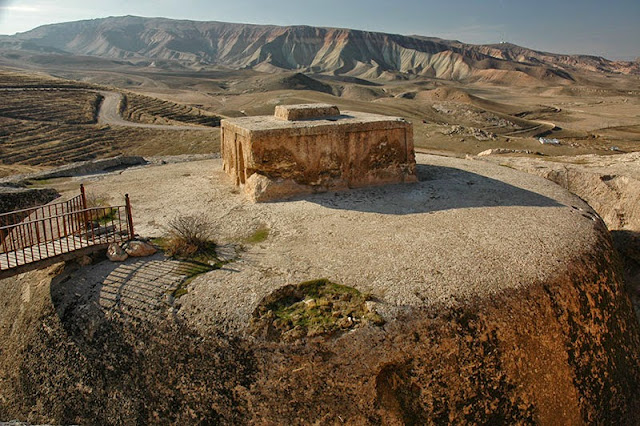
The monastery is known as Nava Vihāra, or New Monastery. Great. Here is where things get interesting for anyone who cares about transliteration, the art of translating alphabets.

In Sanskrit, this is written as नवविहार. 

With a basic Googled Sanskrit alphabet, you can transliterate this and sound out the word, going left to right. Something like "Na-va Va-ha-ra". I had never worked with Sanskrit, so this was a fun little exercise. I think the scythe shape in the middle divides the two words.

In Persian, it's written as نوبهار‎. 

The Arabic alphabet is close enough for me to be able to muddle my way, right to left: "Now Behar". Hmm. Here is where I think internet knowledge went astray. B and V often get mixed up. I have known many Spanish speakers who struggle with the distinction in English. 

In Persian, I read, you cannot start a new word with the و, which can be sounded as 'v' 'w' or 'oo'. So, instead of writing it as "Now Vehar", a Persian speaker heard the name and wrote it down as "Now Behar." And then people got poetic about vihar and bahar.

I understand the desire to connect. A woman once suggested that çok in Turkish (meaning 'a lot') related to the English expression 'chock-a-block.' I felt embarrassed for her ignorance. Then I was the one who went around telling people that computer in Turkish was 'information palace' (sayar vs. saray being my mistake).

Language facts are beautiful enough without us making them up, poetic as the possibilities may be.

Image source: Okar Research Blog

April 6, 2022

A Celtic language in Anatolia


Did you know that in Anatolia, in modern Turkey, people spoke a Celtic language called Galatian?

They did. See that green blob furthest on the right.

History was wasted on me in school. Truly, I didn't appreciate it. Now I listen to the Fall of Civilizations podcast, read biographies of Mohammed and Genghis Khan, and spend hours on Wikipedia trying to get the gist of things.

Thanks to scrolling Wikipedia, I found this tidbit about the Celtic language Galatian. Since Wikipedia has its limitations, I looked to a couple other sources, too.

My major takeaway is that three tribes from Western Europe traveled through the Balkans to Anatolia. The tribes have wonderful names: the Tectosages, Tolistobogii, and Trocmi. Together, members of the tribes ventured east as part of a great Celtic migration in 279 BCE and maintained their language for at least a few hundred years.

Why this little tidbit of history means something to me: I know my ancestry only as the British Isles. To connect those islands with Anatolia, a place I have traveled more extensively and been enlivened by, lights something in me.

I increasingly appreciate history as a study of change. The world changes, changes, changes. What is will not always be. What has been may be again.

In other words, this tidbit dissolves some idea I might have about stasis and isolation. Even thousands of years ago, people traveled, spoke to each other within and across languages, and traded known objects for novel ones. People saw new places and sometimes stayed.

The story of Galatian language also connects to this recurring question: Why do we speak the languages we do?

For example, why do I speak English? Why this English – my specific idiolect – with its current word bank, pronunciation, and ways of construction? Why not a Celtic language?

The answer I imagine as a long story, drawing on trade, politics, war, migration, imperialism, colonialism, economics, landscape, ecology, urbanism, education, philosophy, media, and many more fields.

I wonder if an inquiry approach would have changed my experience of history in school. I doubt I would have posed the questions above. I would have posed a question, though, had someone prompted. And I may have found this inner flame, which guides me to search, read, think, and reflect with so much pleasure.

Sadly researchers have not much found much preserved Galatian language. Mostly people's names. I did read through the names, looking for familiarity, but they seem truly foreign to me.


Additional sources: 2016 university thesis on "The Ethnic Identity and Redefinition of the Galatians in the Hellenistic World"; 2002 review of The Galatian language : a comprehensive survey of the language of the ancient Celts in Greco-Roman Asia Minor.

Image from Wikipedia: By QuartierLatin1968,The Ogre,Dbachmann; derivative work Rob984. - Derived from File:Celts in Europe.png, omission of the early modern stage. Sources for data: See File talk:Celts in Europe.png, CC BY-SA 4.0, https://commons.wikimedia.org/w/index.php?curid=50243888

March 16, 2022

Wiki Friday: books, science, trends


Author of The Salt Path

I was trying to remember it, after enjoying the book so much. Raynor Winn – a memorable name. Her partner goes by Moth. Winn relays the story of walking the coast of England, after the couple have lost all their money and learned that Moth has a degenerative terminal disease. 

How happy I was that the book had been written. I don’t often see travel memoirs from people who are not just trying to save money, but who are truly poor. How is homelessness perceived when people are on a touristic trail, versus in a city? What role does age play?

I was curious if Winn had written another book. Indeed she has — The Wild Silence. From summaries I see it is about life after trauma and rewilding a property. 

More recently, and on that note, I read Wilding by Isabella Tree, which captures the challenges of attempting to return land to a previous state. It makes me think of neo-paganism and the challenges of reconstruction. Looking forward to reading this second book by Winn.

Why is the sky blue

Frequency
Vibration
Oscillation
Scattered light
Blue scatters the most
A reminder that rainbow colours together are white
Why clouds are white
Droplets
Sunsets 
Our chance to see the other colours coming from the sun

Earthworms

I have been walking around and amazing people with the factoid that earthworms were introduced to North America. 

Is this actually true? No. 

Apparently some earthworms are native here. Others have been introduced, and indeed some are considered invasive, especially in forests where they consume fallen leaves which would normally decompose. Species who live all over the world are called peregrine or cosmopolitan earthworms, which is a bit funny.

Honey bees

Honey bees defending their hive by swarming two hornets; the heat they generate can kill

Okay, this factoid really is accurate:

No honey bees lived in North America during human times until introduced by Europeans. 

I learned that of the 20,000 bee species alive today, only 8 are honey bees. 

Slow Food 

McDonalds resistance
Bra (the town)
Carlo Petrini, now 72, contributing culinary articles to communist newspapers
Turin/Torino
Terra Madre Salone del Gusto
Should I learn Italian?
Critiques of elitism
Alice Waters
Turkey